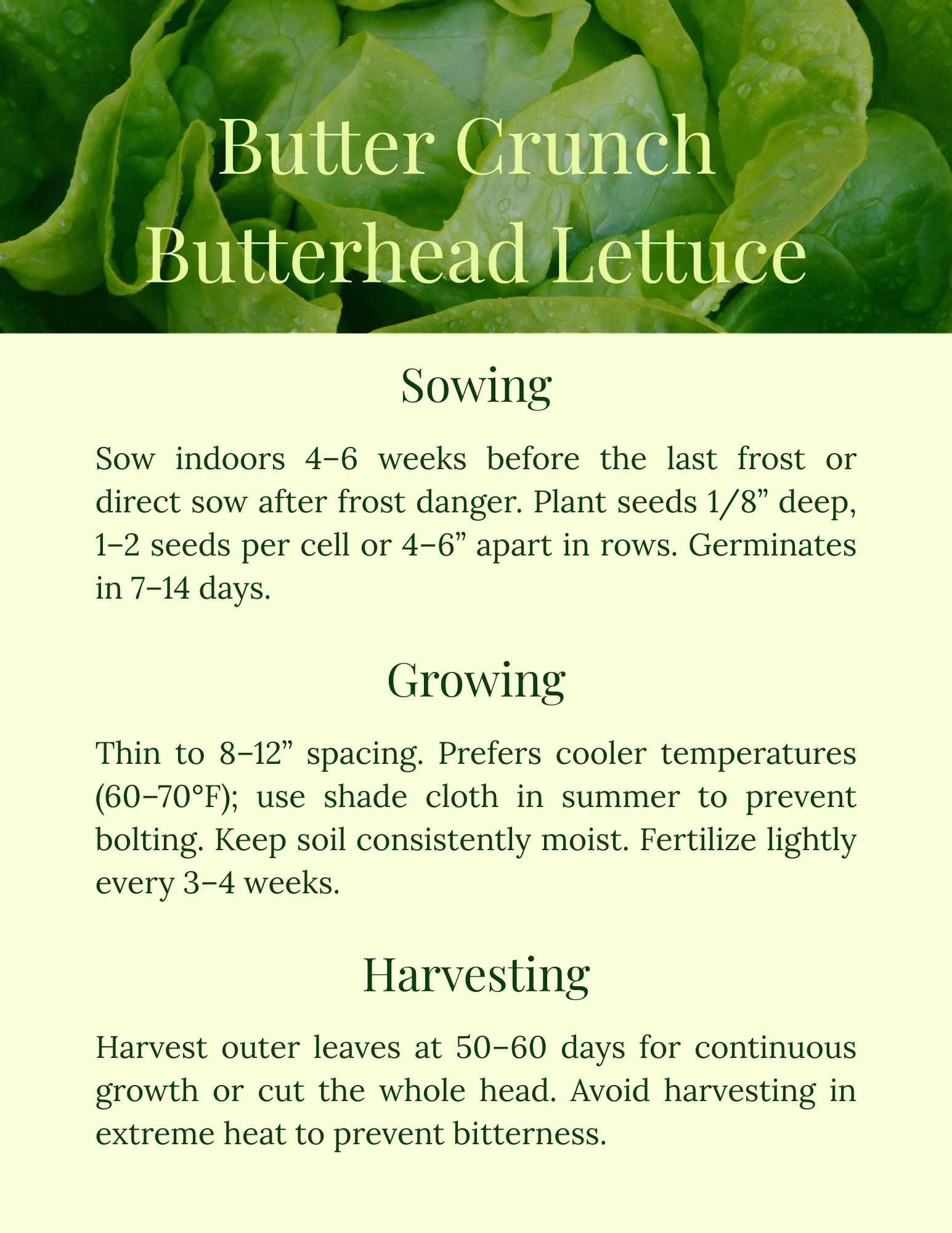
Butter Crunch Butterhead Lettuce
Sowing
Buttercrunch Butterhead lettuce seeds grow well in cool weather, so the first crop can be direct sown when the soil temperature reaches at least 35 degrees F, or as soon as the soil can be worked. If the soil temperature rises above 75 degrees F, the seeds become dormant. Direct sow the seed in rich soil and full sun, spreading them as thinly as possible in rows 1-2′ apart; when the seedlings begin to grow, thin them to a distance of 8-12″. Succession crops can be grown for fresh lettuce all season in areas with cool summers or warm winters; this is accomplished by planting a new crop every 2 weeks. For companion planting benefits, grow lettuce with onions, cucumbers, or carrots.
Growing
Since lettuce has very shallow roots, it needs adequate moisture in order to stay tender and sweet; keep the soil evenly moist. Applying mulch helps conserve moisture and control weeds. Buttercrunch lettuce is quite heat resistant.
Harvesting
Buttercrunch lettuce retains its crisp sweetness best when harvested in the morning. For microgreens, cut the entire plant above the surface of the soil as soon as it reaches a height of 2-3″. Outer leaves of the plant can be gathered all season until the main stem of the plant starts to grow, at which time the leaves will grow bitter. To harvest the entire plant when mature, cut it just above the surface of the soil; lettuce tastes best when fresh, but keeps in the refrigerator for about a week.
Seed Saving
As the days of summer begin to lengthen, the lettuce will bolt, or send up a stalk. To avoid selecting negative traits, gather seed from the plants that are slow to bolt. After the stalk flowers and produces pods, the pods will turn light brown and split open; in order to prevent seed loss, shake the head of the stalk into a bag every day. Alternatively, some seed savers remove the entire plant when most of the pods are ready for harvest, and hang it upside down to dry in a protected location. Shake these bibb lettuce seeds from the pods or crush the pods in your hands. The seed will have white “feathers” on them that can be removed by rubbing the seed on a fine mesh screen. Store Buttercrunch Butterhead lettuce seeds in a cool, dry place for 2-3 years.
Common Pests
Aphids: The common name for many species of aphids that infect gardens is plant lice, as that is exactly what they look like. Aphids sucks plant juices, weakening the leaves and the stems. Fortunately there are a dozen major predators to every type of aphid. The most common predator are the lady beetle, small wasps, syrphid fly larvae, and lacewings. Most of the time insecticide is not needed for removing aphids, a strong stream of water from the hose will do just fine, as will soapy water.
Slugs: Slimy moving lumps that leave a trail behind them, a mollusk more then a insect. a few slugs in your garden is fine, but if damp weather combined with a suitable habitat, your garden can become so thick with slugs that no leafy green is left unslimed. Besides changing the lay out of your yard, you can limit slug allure by keeping the lower branches of bushes pruned so that they do not become sheltered slug castles. Perhaps the oldest slug remedy is salt, which dehydrates slugs when you sprinkle it on them. Salting is best done by hand becasue it is important to limit the amount of salt that ends up in the soil.